

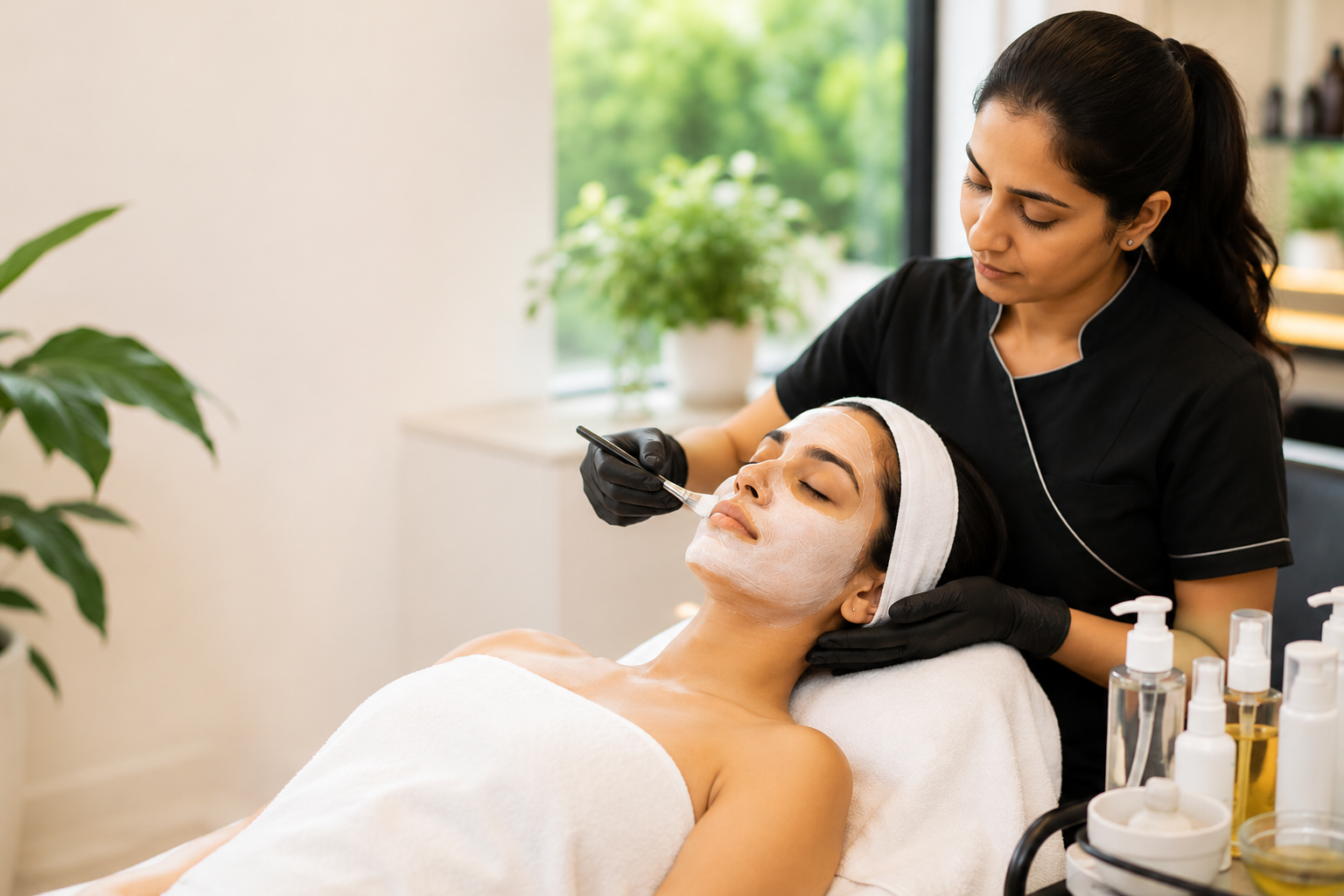
June is the month when most people either give up on skincare entirely (“what is the point in this heat”) or throw everything at their face and make things worse. Both are understandable reactions to what Indian summer does to skin: pores clog faster, oil production goes up, and whatever you could get away with in the cooler months suddenly stops working. The facials you need in summer are genuinely different from what works in winter — and getting the right one at a professional salon can reset your skin for the season. At Hair Masters, our summer facials are formulated for the specific demands of oily, heat-stressed, humidity-exposed Indian skin.
Key Takeaways
- Summer Skin Needs Different Things: The heavy hydration facials that work in winter often aggravate oily summer skin. Lighter, balancing treatments are more effective.
- De-Tan Is Not Optional: UV tanning in North Indian summers is aggressive. A professional de-tan facial uses ingredients that home products cannot match for concentration or effect.
- Frequency Matters: Once a month through summer is the minimum to keep pores clear and prevent the congestion that leads to breakouts.
- Post-Facial Protection: A facial is only as good as your sunscreen habit. Skipping SPF after a facial undoes the work quickly.
What Humid Weather Does to Your Skin
Indian summers, particularly in Delhi, Gurugram, Chandigarh, and the Punjab belt, combine peak UV intensity with escalating humidity as you approach monsoon. This combination is specifically difficult for skin. High UV drives melanin production (tanning, uneven tone, dark spots) while humidity causes your skin to produce more sebum and your pores to appear larger as they work harder to regulate temperature.
The result for most people: shiny, congested skin by midday even when they have cleansed in the morning, more frequent breakouts, and a visible tan that regular face washes do not shift. The skin is not malfunctioning — it is doing exactly what it is designed to do under stress. The question is how to manage it without stripping the skin’s protective barrier in the process.
| Skin Type | Summer Concern | Recommended Facial |
|---|---|---|
| Oily / Combination | Excess shine, clogged pores, breakouts | Deep Cleansing + Purifying Facial |
| Normal / Dry | Dehydration despite heat, dullness | Hydrating Facial with Hyaluronic Acid |
| Sensitive | Redness, heat rash, reactivity | Calming / De-Sensitising Facial |
| All Types (Tanning) | Uneven tan, dark spots | De-Tan Facial + Vitamin C Treatment |
The Facials Worth Getting in June
Deep Cleansing Facial (Oily and Combination Skin)
This is the most requested facial at Hair Masters through summer, and for good reason. A professional deep cleanse goes beyond what home skincare can reach. Steam opens pores, followed by a targeted extraction to clear blocked sebum and debris, then a purifying mask formulated to reduce pore appearance and control oil without dehydrating the skin.
The key difference between a salon deep cleanse and a home routine is the extraction step. Incorrect extraction at home (squeezing, pressing hard) can cause capillary damage and push bacteria deeper into pores. Done properly by a trained facialist, it genuinely clears congestion and reduces the frequency of breakouts for weeks.
De-Tan Facial (All Skin Types, Especially Active Outdoor Skin)
De-tan treatments use a combination of exfoliating acids, vitamin C, and brightening enzymes to break down the melanin clusters that form from UV exposure. At salon concentration levels, these ingredients work significantly faster than OTC products. A single de-tan session can visibly shift three to four weeks of tan accumulation.
For best results, come in every three to four weeks through summer and use a broad-spectrum SPF 50 daily. Without the sunscreen habit, the tan simply comes back faster than you can clear it, and you end up in a cycle. The facial does the work; the sunscreen protects the result.
Hydrating Facial with Hyaluronic Acid (Dry and Normal Skin)
Counterintuitively, dry skin can get more dehydrated in summer, not less. Exposure to AC environments, sweating, and UV collectively pull moisture from skin faster than the skin can replace it. A hydrating facial uses humectants — most commonly hyaluronic acid — that pull moisture into the skin and help the skin barrier retain it.
If your skin feels tight after cleansing, or you are seeing flakiness despite the heat, this is the facial for you. It is lighter than a winter moisturising treatment but significantly more effective at restoring skin hydration than simply applying a heavy moisturiser on top.
What to Do Before and After Your Facial
You will get more from a facial with a little preparation and follow-through:
- Before: Avoid retinol, AHA/BHA products, or any active exfoliants for 48 hours before your appointment. Exfoliating on already-sensitised skin before a facial can cause irritation.
- After: Apply SPF before stepping out, even if the sky looks overcast. UV penetrates cloud cover. This is the single most important post-facial step.
- That day: Avoid heavy exercise or anything that causes significant sweating for 24 hours post-facial. Your pores are clear and temporarily more open; sweat-soaked skin re-congests quickly.
- Product choices: Stick to minimal, gentle products for 24 hours after your facial. A gentle cleanser, a light moisturiser, and SPF. No actives until the following day.
Frequently Asked Questions
Q1. Can I get a facial if I already have active acne?
Yes, but tell your facialist before the session starts. Active acne changes what products and techniques are safe to use. A trained salon professional can work around active breakouts and use anti-bacterial, calming formulations rather than anything potentially irritating.
Q2. How often should I be getting a facial in summer?
For most skin types, once a month is the baseline. If you have oily or acne-prone skin, or if you spend significant time outdoors, every 3 weeks is reasonable through June and July. Your skin’s pace of congestion will tell you what frequency actually works.
Q3. Will a de-tan facial make my skin sensitive to sun immediately after?
Yes — any treatment involving exfoliating acids temporarily increases photosensitivity. Do not skip SPF after a de-tan facial; if anything, be more diligent about it in the 48 hours following your treatment.
Q4. I have sensitive skin. Which summer facial is safest?
A calming, fragrance-free hydrating facial is the safest starting point for sensitive skin. Let your facialist know your sensitivity triggers and any products that have caused reactions before. Hair Masters uses professional-grade products where formulations can be adjusted to suit sensitive skin.
Conclusion
Getting a facial in summer is not a luxury — for most Indian skin types dealing with this climate, it is practical maintenance. The congestion, tanning, and dehydration that accumulate over the summer months are much easier to manage with regular professional intervention than to fix after they have built up over months.
Walk into any Hair Masters salon near you for a skin consultation before your first summer facial. Our trained facialists will look at your skin’s current condition and recommend the most appropriate treatment — not a generic one-size-fits-all facial, but something matched to what your skin is actually dealing with right now.